
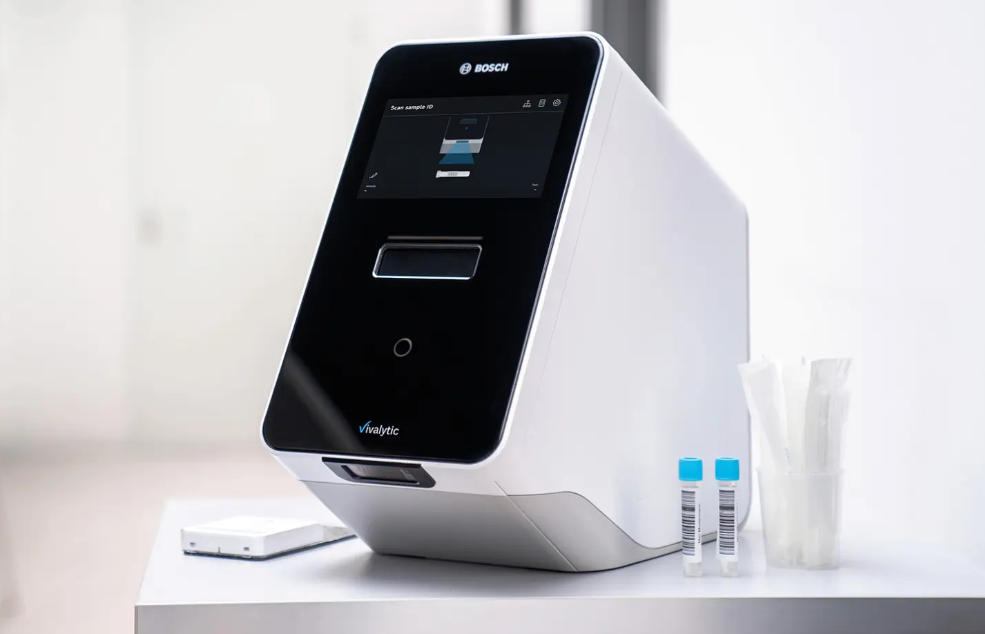
A PCR machine is one of the most important pieces of equipment used in modern molecular diagnostics. It enables laboratories to detect genetic material that is associated with viruses, bacteria, fungi and other microorganisms, and then providing information that can support the diagnosis and management of infectious diseases.
However, not every PCR machine works in the same way.
Traditional molecular laboratories may use separate equipment and manual processes for:
- sample preparation,
- nucleic-acid extraction,
- amplification,
- detection and interpretation.
Newer automated systems can integrate much more of this workflow into a single platform.
For hospitals and diagnostic facilities considering a PCR machine laboratory setup, the right question is not simply:
“Which PCR machine should we buy?”
It now becomes:
“What molecular diagnostic capability does our laboratory or centre actually need?”
- The Bosch Vivalytic Analyser provides an interesting example of how modern PCR systems are changing this discussion.
Rather than functioning solely as a conventional thermal cycler, Vivalytic integrates several stages of molecular testing into a compact, cartridge-based platform.
What Is a PCR Machine?

PCR stands for polymerase chain reaction.
The technique allows specific sections of genetic material to be amplified so that they can be detected and analysed. In clinical molecular diagnostics, this makes it possible to look for genetic targets associated with particular pathogens.
A PCR machine may therefore be used as part of testing for:
- respiratory infections;
- gastrointestinal infections;
- sexually transmitted infections;
- healthcare-associated infections;
- meningitis;
- and many other infectious diseases.
However, the phrase PCR machine covers a broad range of equipment.
- At one end are laboratory instruments designed primarily to perform amplification and detection. These can form one component of a larger molecular laboratory workflow.
- At the other are highly automated systems that integrate sample processing, extraction, amplification and detection.
Understanding that difference is important when comparing equipment.
How Does a PCR Machine Work?
At its simplest, PCR works by repeatedly heating and cooling a sample through carefully controlled temperature cycles.
These cycles allow selected genetic material to be copied repeatedly.
With real-time PCR, amplification can be monitored during the process using fluorescent signals, which enables the system to detect whether the genetic target being investigated is present.
However, clinical molecular diagnostics involves considerably more than amplification alone.
Before PCR can take place, a patient specimen may require preparation and nucleic-acid extraction. After amplification, the resulting signals must be detected, analysed and reported.
A conventional PCR laboratory can therefore involve several pieces of equipment and multiple manual steps.
This is one of the areas where automated molecular diagnostic platforms differ.

What Does a PCR Machine Laboratory Need?
A PCR machine laboratory traditionally requires much more than the PCR instrument itself.
Depending on the tests being performed, a molecular laboratory may require:
- sample-preparation areas,
- extraction equipment,
- pipettes,
- centrifuges,
- refrigerators or freezers,
- PCR workstations,
- computers and other laboratory infrastructure.
Workflow design is also important because molecular laboratories need procedures to minimise contamination and maintain appropriate quality standards.
The exact requirements depend on the type of testing being undertaken.
This is why purchasing a PCR machine should not be considered in isolation, so a laboratory MUST consider the complete sample-to-result workflow.
That includes:
Sample collection → Preparation → Extraction → Amplification → Detection → Interpretation → Reporting.
A system that automates several of these processes may have very different infrastructure and staffing requirements when compared to a conventional PCR setup.
Traditional PCR Machine vs Automated/Real-Time PCR.

First off, neither approach is automatically better.
Large central laboratories that process substantial numbers of specimens may benefit from conventional, high-throughput molecular systems and specialised workflows.
Smaller laboratories, hospitals and facilities that need rapid individual results may have different priorities.
A simplified comparison may look like this:
| Consideration | Conventional PCR Laboratory | Automated Cartridge-Based PCR |
|---|---|---|
| 1. Sample preparation | Often separate/manual | Can be highly automated |
| 2. Nucleic-acid extraction | May require separate process/equipment | Can occur within system |
| 3. PCR amplification | Dedicated PCR equipment | Integrated |
| 4. Detection | Instrument dependent | Integrated |
| 5. Reagents | Laboratory preparation/kits may be required | Assay-specific cartridge |
| 6. Specialist workflow | Usually greater | Often simplified |
| 7. Flexibility | Potentially very high | Limited to available assays |
| 8. Throughput | Can be suited to large batches | Platform dependent |
| 9. Hands-on steps | Potentially greater | Reduced on automated systems |
| 10. Infrastructure | Can require several devices | Potentially more compact |
This highlights an important purchasing consideration: The cheapest PCR machine is not necessarily the lowest-cost PCR laboratory.
Equipment, consumables, staffing, infrastructure, maintenance, quality control and sample throughput all contribute to the total cost of providing molecular diagnostics.
What Is the Bosch Vivalytic PCR Machine?

Vivalytic is Bosch’s automated molecular diagnostics platform.
- Strictly speaking, describing Vivalytic simply as a PCR machine understates what the system does.
Bosch describes Vivalytic as consisting of a compact Analyser and assay-specific cartridges. The system combines several molecular analysis methods and automates much of the process between introducing the sample and receiving the result.
The Analyser can support qualitative and quantitative PCR, melting-curve analysis and microarray-based detection – depending on the assay.
This makes Vivalytic closer to an automated molecular diagnostic platform than a conventional standalone PCR thermal cycler.
1. What Happens Inside the Vivalytic Analyser?

One of the major differences between Vivalytic and a conventional PCR workflow is automation.
Bosch describes 5 principal stages performed within the system:
1. Sample preparation
The specimen is prepared for molecular analysis.
2. Cell lysis
Ultrasound is used to disrupt cellular structures and release genetic material.
3. Nucleic-acid extraction
DNA or RNA is purified for subsequent amplification.
4. DNA Amplification
Relevant genetic sequences are amplified using the appropriate molecular process.
5. Detection
The amplified genetic material is identified through the relevant detection technology.
In a conventional molecular laboratory, some of these processes can involve different instruments and manual procedures.
With Vivalytic, they are integrated into the analyser and cartridge workflow.
2. A Four-Step User Workflow

From the operator’s perspective, Bosch describes the Vivalytic process in four main actions:
Scan the sample → scan the cartridge → add the sample and close the cartridge → insert the cartridge.
The test then begins automatically.
This simplified workflow is one of the main reasons an automated PCR platform may be attractive to facilities seeking to introduce or decentralise molecular testing.
What Can the Vivalytic PCR Machine Test For?
A PCR machine has little clinical value without appropriate assays.
Vivalytic currently supports 13 assays that cover several areas of infectious disease, including:
- Respiratory
- Gastrointestinal
- UTIs* & sexually transmitted infections
- Nosocomial infections
- and bacterial meningitis.
Below is a simple breakdown at a glance:
| Vivalytic Assay | Detectable Pathogens/Targets | Approx. Test Time |
|---|---|---|
| 1. SARS-CoV-2 DT | SARS-CoV-2 | ~30–50 min, depending on current assay/version information |
| 2. Bordetella | B. pertussis, B. parapertussis, B. holmesii | ~47 min |
| 3. C. difficile | C. difficile tcdA/tcdB | ~54 min |
| 4. MRSA/SA | MRSA and MSSA | ~55 min |
| 5. Bacterial Meningitis | 6 bacterial pathogens | ~56 min |
| 6. Respiratory Multiplex | SARS-CoV-2 Flu A/B RSV | ~60 min |
| 7. Norovirus | Norovirus GI/GII | ~60 min |
| 8. Gastrointestinal Multiplex | Norovirus Rotavirus A C. difficile | ~60 min |
| 9. Candida auris | C. auris | ~60 min |
| 10. MG/MH/UP/UU | Mycoplasma and Ureaplasma targets | ~60 min |
| 11. UTI* | 16 uropathogens + selected AMR genes | ~90 min |
| 12. STI Multiplex | 10 sexually transmitted pathogens | ~2 hr 20 min |
*Regulatory status and availability should be confirmed for the relevant market. Some Vivalytic products are Research Use Only or under development.
As you can see above, some assays detect a single pathogen or small group of closely related targets.
Others are multiplex PCR tests, that allow for several pathogens to be investigated simultaneously.
This type of breadth matters when considering the business case for a PCR machine laboratory.
So instead of purchasing an analyser for one disease, a laboratory can consider how many of its existing or planned molecular testing requirements could potentially be addressed using the same platform.
Can a PCR Machine Reduce Reliance on External Laboratories?
For some healthcare facilities, this may be one of the strongest reasons to investigate automated molecular diagnostics.
A hospital without local PCR capability may need to:
- collect the specimen;
- package it;
- arrange transportation;
- send it to a central laboratory;
- wait for processing;
- and receive the result electronically or manually.
The analytical test itself might be relatively fast, but the entire diagnostic pathway may not be.
An appropriate PCR machine located within the hospital or laboratory can potentially move selected molecular tests closer to where the result is required.
Bosch specifically positions Vivalytic for use in laboratories, hospitals and selected point-of-care environments.
This could be particularly relevant to healthcare facilities where specimen transport represents a meaningful part of existing turnaround times.

Does a Vivalytic PCR Laboratory Need Additional Equipment?
One of Vivalytic’s distinguishing features is that Bosch designed the system to reduce peripheral equipment requirements.
- For its laboratory configuration, Bosch states that the Analyser does not require additional peripherals such as a separate laptop, keyboard, barcode scanner or filling station.
Each cartridge contains the reagents required for the particular test and is compatible with the Vivalytic Analyser. Sample processing is then performed within the automated workflow.

This can simplify the physical setup compared with a conventional multi-stage molecular laboratory.
- It does not mean a healthcare facility can simply place the analyser on a desk and begin clinical testing without further consideration.
Appropriate laboratory procedures, specimen handling, quality control, biosafety, waste disposal, staff training and applicable regulatory requirements remain necessary.
1. Singleplex vs Multiplex PCR Testing
Another important consideration is whether the PCR machine supports singleplex and multiplex testing.
- Singleplex testing typically concentrates on one principal target or pathogen.
- Multiplex PCR allows multiple genetic targets to be analysed within the same assay.
Vivalytic supports both approaches.
- For example, a respiratory multiplex assay can investigate 4 pathogens including SARS-CoV-2, Influenza A, Influenza B and RSV together.
Multiplex testing can be particularly useful where several pathogens may produce overlapping clinical presentations.
2. What Should You Consider Before Buying a PCR Machine?
Price is naturally important, but the analyser purchase price represents only part of the decision.
A laboratory should consider the entire testing programme, including:
- assays available for the platform;
- pathogens and targets covered;
- expected test volumes;
- assay turnaround times;
- hands-on staff requirements;
- cartridge and consumable costs;
- availability of consumables;
- quality-control requirements;
- staff training;
- laboratory space;
- power and infrastructure requirements;
- LIS/HIS connectivity;
- maintenance and servicing;
- technical support;
- regulatory status of individual assays;
- and total cost per useful test result.
For healthcare facilities in African markets, supply and support deserve particular attention.
An advanced PCR machine has limited value if cartridges cannot be reliably obtained or technical assistance is unavailable when required.
Procurement therefore needs to consider the analyser, assays and after-sales ecosystem together.
Is an Automated PCR Machine Suitable for Every Laboratory?
Not necessarily.
- A major reference laboratory may require very high throughput, highly flexible assay development and specialist molecular capabilities.
- A smaller diagnostic laboratory may prioritise automation and ease of use.
- A hospital may prioritise rapid results for specific urgent conditions.
- A clinic may have insufficient testing volume to justify buying molecular diagnostic equipment at all.
In some situations, continuing to refer specimens to a central laboratory will remain the most practical and economical solution.
This is why MediDiagAfrica’s approach should begin with the facility’s requirements rather than the product.
So the first questions should be:
- What tests do you currently send elsewhere?
- How many samples do you process?
- How long do results currently take?
- Which pathogens are most important to your patients?
- Would bringing some molecular testing in-house improve the existing diagnostic pathway?
Only then does the question of equipment become meaningful.
Explore the Vivalytic PCR Machine With MediDiagAfrica
If your hospital, clinic or diagnostic laboratory is considering a PCR machine laboratory setup, MediDiagAfrica can help you explore whether the Bosch Vivalytic molecular diagnostics platform matches your testing requirements.
We can discuss the assays your facility requires, expected testing volumes, existing laboratory workflow and the molecular tests you currently perform internally or send to external laboratories.
From there, healthcare decision-makers can decide whether Vivalytic represents an appropriate addition to their diagnostic capabilities.
Contact Us to discuss your laboratory’s PCR requirements or enquire about a demonstration.
Individual Vivalytic assay availability, intended use and regulatory status can vary by market. Healthcare organisations should confirm current product specifications and local availability before procurement.