
Bacterial meningitis remains one of the most serious infectious diseases faced by African healthcare professionals. Although several bacteria can cause meningitis, identifying the organism responsible can be important for patient management, infection control and wider public-health surveillance.
The World Health Organization (WHO) describes meningitis as a medical emergency requiring urgent medical attention. Bacterial meningitis can become fatal within 24 hours, and around one in five people affected can experience long-term complications.
For laboratories, hospitals and healthcare facilities, this creates an important diagnostic challenge: how can suspected bacterial meningitis be investigated quickly while providing clinicians with useful information about the pathogen involved?
Molecular diagnostic technologies such as PCR are increasingly important within this process.
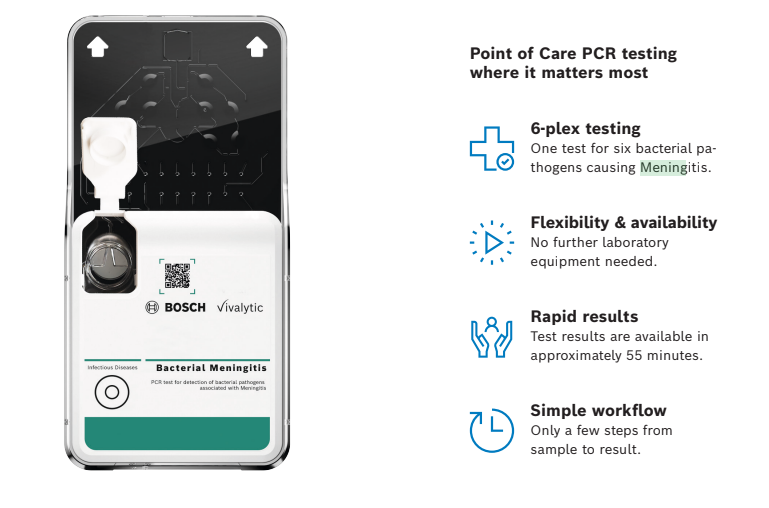
The Bosch Vivalytic Bacterial Meningitis test provides qualitative real-time PCR detection of six important bacterial pathogens from cerebrospinal fluid (CSF), with results available in approximately 56 minutes.
For laboratories and healthcare facilities evaluating molecular diagnostic capabilities, this offers an interesting approach to rapid multiplex testing.
What Is Bacterial Meningitis?

Meningitis is an inflammation of the tissues surrounding the brain and spinal cord. It can be caused by bacteria, viruses, fungi, parasites and other organisms.
Bacterial meningitis is particularly concerning because of how quickly severe illness can develop.
WHO reported that approximately 1.6 million bacterial meningitis cases occurred globally in 2019, resulting in around 240,000 deaths. The burden remains particularly high in low- and middle-income countries, including countries within the African meningitis belt.
Common symptoms can include:
- fever,
- headache,
- neck stiffness,
- confusion or altered mental status,
- vomiting and sensitivity to light.
Presentation can differ by age and clinical circumstances, however, and suspected bacterial meningitis requires urgent medical assessment.
Importantly, laboratory testing is not simply about establishing that meningitis may be present.
Healthcare professionals may also need to determine which pathogen is responsible.
Why Identifying the Bacterial Pathogen is Important
Different bacterial species can cause meningitis.
Identifying the causative organism can contribute to clinical decision-making and can also be important for disease surveillance and outbreak response.
WHO highlights that early detection and rapid diagnosis as important both for individual patient management and the management of meningitis epidemics. So identifying the responsible pathogen at the beginning of an outbreak can help inform the appropriate public-health response.
This makes laboratory diagnostic capacity particularly important in regions where meningitis continues to present a significant public-health challenge.
For laboratories, the question therefore becomes not merely whether testing is available, but also how quickly clinically relevant pathogens can be identified.
How Is Bacterial Meningitis Diagnosed?
Cerebrospinal fluid (CSF) plays a central role in investigating suspected meningitis.
WHO states that diagnosis involves lumbar puncture to obtain and examine CSF. Where bacterial meningitis is suspected, however, obtaining a lumbar puncture should not delay antibiotic treatment.
Laboratory investigation can involve several approaches, including examination of CSF, microscopy, culture and molecular testing.
PCR – or polymerase chain reaction – can detect genetic material associated with particular pathogens.
This can make molecular testing particularly useful where laboratories need to investigate several possible infectious agents.
However, an important distinction needs to be made.
PCR complements rather than simply replaces conventional microbiology
Rapid PCR testing should not be presented as making every other laboratory method unnecessary.

WHO’s 2025 meningitis guidelines specifically state that CSF culture and antimicrobial susceptibility testing should not be replaced by PCR and should routinely be performed as the gold-standard tests for pathogen identification and characterisation of antibiotic resistance profiles.
The practical value of molecular testing is therefore better understood as part of the broader diagnostic workflow.
It can provide laboratories with rapid pathogen detection while conventional microbiological investigations continue to provide additional information.
For laboratory managers considering molecular diagnostic equipment, this distinction is important.
Six Bacterial Meningitis Pathogens in One Vivalytic Test.

One of the advantages of multiplex molecular diagnostics is the ability to test for several pathogens within a single assay.
The Vivalytic Bacterial Meningitis test is designed to detect six bacterial pathogens:
| Pathogen | Included in Vivalytic Bacterial Meningitis Test |
|---|---|
| Escherichia coli | Yes |
| Streptococcus agalactiae | Yes |
| Haemophilus influenzae | Yes |
| Listeria monocytogenes | Yes |
| Neisseria meningitidis | Yes |
| Streptococcus pneumoniae | Yes |
The Bosch Vivalytic brochure describes the assay as a 6-plex test, allowing one test to investigate these six bacterial pathogens associated with meningitis.
This can be particularly relevant where the causative pathogen is not immediately apparent from the patient’s clinical presentation.
How Does the Vivalytic Bacterial Meningitis Test Work?
The Vivalytic Bacterial Meningitis assay uses qualitative real-time PCR.
- The sample material is cerebrospinal fluid (CSF) and the required sample volume is 300 μL per test.
- Bosch states that results are available in approximately 56 minutes.
The main specifications are:
| Specification | Vivalytic Bacterial Meningitis |
|---|---|
| Detection Method | Qualitative real-time PCR |
| Sample Material | Cerebrospinal fluid (CSF) |
| Pathogens Detected | 6 bacterial pathogens |
| Time-to-Result | Approx. 56 minutes |
| Sample Volume | 300 μL per test |
| Transport Medium | No transport medium |
| Application | Symptomatic patients |
| Intended Setting | Professional and laboratory use |
The broader Vivalytic platform is designed as an automated molecular diagnostic system capable of supporting different detection technologies.
Bosch describes the system as user-friendly and able to provide both an easy-to-understand result summary and more detailed measurement data.
What Could a Result in Approximately 56 Minutes Mean for a Laboratory?
The significance of a shorter time-to-result needs to be considered within the complete clinical pathway.
- A PCR result does not replace clinical assessment, nor does it remove the need for other microbiological investigations where indicated.
However, receiving molecular results for six bacterial targets in approximately 56 minutes could potentially give healthcare professionals useful pathogen information much earlier in the diagnostic process than workflows dependent solely upon slower methods.
For a laboratory manager or clinic considering molecular diagnostics, this raises practical questions such as:
- How long does our current meningitis testing pathway take?
- Are samples routinely sent to another laboratory?
- How quickly can clinicians currently receive pathogen-specific information?
- Which meningitis pathogens can we detect on site?
- How much specialist molecular laboratory infrastructure does our existing process require?
- Could multiplex PCR complement our existing culture and antimicrobial susceptibility testing workflow?
These questions are often more meaningful than comparing instruments solely on technical specifications.
Could Vivalytic Be Suitable for Laboratories with Limited Molecular Infrastructure?

This is another area where the design of the overall Vivalytic platform becomes relevant.
Bosch states that the system can be set up where it is required and that the Bacterial Meningitis assay does not require further laboratory equipment as part of its test workflow. The manufacturer describes the process as requiring only a few steps from sample to result.
That may make the system worth evaluating for healthcare organisations looking to introduce or expand molecular testing without developing a conventional PCR workflow around every individual assay.
Whether it is appropriate for a particular laboratory will, of course, depend on factors including expected testing volumes, existing laboratory infrastructure, staffing, procurement costs, consumable availability, quality-management requirements and local regulatory requirements.
This is why a discussion or demonstration can be more useful than looking at specifications alone.
One Vivalytic Platform, Multiple Molecular Tests
Bacterial meningitis testing is only one part of the Vivalytic portfolio.
The same Vivalytic system supports assays across several infectious-disease areas. The current Bosch portfolio brochure includes tests covering:
Respiratory infections, including SARS-CoV-2, Influenza A/B, RSV and Bordetella;
Gastrointestinal infections, including Clostridioides difficile, Norovirus and Rotavirus;
Sexually transmitted infections, including multiplex STI testing and tests covering Mycoplasma and Ureaplasma;
Nosocomial infections, including MRSA/SA and Candida auris; and
Bacterial meningitis, covering the six pathogens discussed above.
For healthcare facilities, therefore, the decision to evaluate Vivalytic does not necessarily need to revolve around one disease.
A more useful question may be whether a single molecular diagnostic platform could support several testing requirements within the organisation.
Interested in Vivalytic Bacterial Meningitis Testing?
If your laboratory, clinic, hospital or healthcare organisation is reviewing its molecular diagnostic capabilities, MediDiagAfrica can provide further information about the Bosch Vivalytic platform and its available test portfolio.
We can discuss your current testing requirements, the pathogens your facility needs to detect and whether the Vivalytic platform may be appropriate for your organisation.
Request information about the Vivalytic Bacterial Meningitis test
Ask about a Vivalytic demonstration
Discuss molecular diagnostic requirements for your laboratory or healthcare facility
Product availability can differ between markets. Bosch advises healthcare organisations to confirm the availability of specific Vivalytic products within their region.
This article is intended for healthcare and laboratory professionals and provides general product and diagnostic information. It should not be used as a substitute for clinical guidelines, professional medical judgement or local diagnostic protocols.