
When healthcare professionals search for a rapid PCR test, speed is usually only part of the question.
- The more important consideration is how quickly a laboratory can move from collecting a patient sample to obtaining useful molecular diagnostic information.
Traditional PCR testing can involve multiple manual processes, specialist laboratory equipment and, where testing is centralised, transportation of specimens to another facility. Modern automated molecular diagnostic platforms are designed to simplify parts of that process and bring PCR testing closer to the patient.
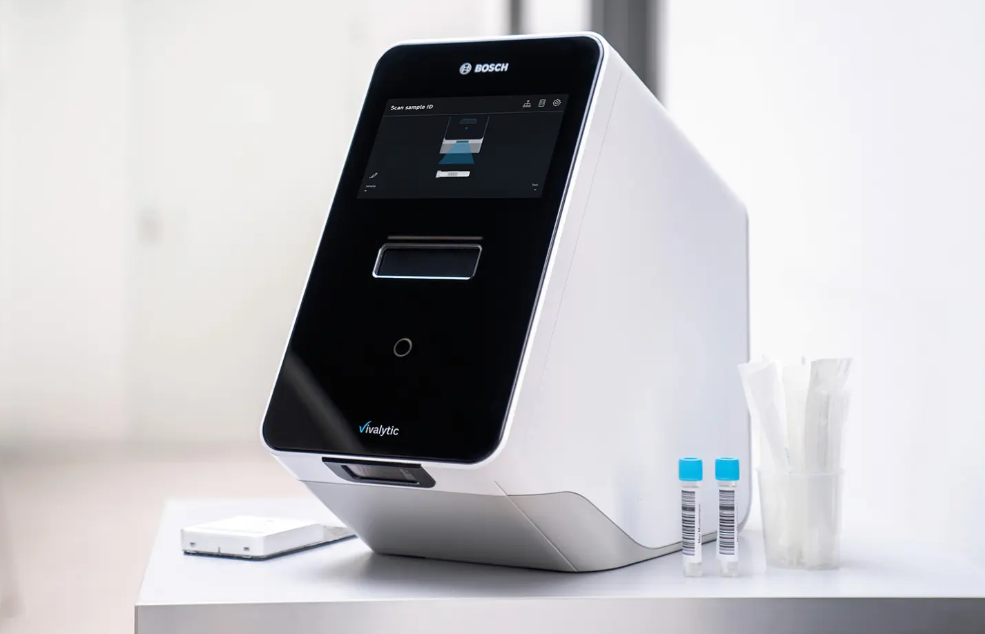
The Bosch Vivalytic Analyser is one example.
- It combines a compact analyser with application-specific cartridges and automates several stages of molecular testing. Depending on the assay, Vivalytic PCR testing can take from approximately half an hour to more than two hours. Bosch describes the system as an all-in-one solution for rapid PCR testing that can operate directly at the point of care.

- But what actually makes a PCR test “rapid”?
- What should a hospital or laboratory consider when looking for a fast PCR test?
- And is the fastest PCR test necessarily the best choice?
What Is a Rapid PCR Test?
PCR, or polymerase chain reaction, is a molecular technique used to detect specific genetic material.
In infectious-disease diagnostics, PCR can be used to identify genetic targets associated with viruses, bacteria, fungi and other pathogens.
A rapid PCR test generally refers to a PCR-based assay designed to provide results considerably faster or with a simpler workflow than conventional laboratory testing pathways.
- There is no single universal time that makes a PCR test “rapid”.
A 30-minute assay may be rapid.
A 60-minute multiplex test detecting several pathogens may also reasonably be described as rapid.
Even a longer molecular assay may offer a useful turnaround advantage if the existing alternative requires sending a sample to an external laboratory.
For this reason, healthcare organisations should look beyond the word rapid and ask:
How long will it actually take us to obtain a usable result in our facility?
This distinction becomes more important when comparing molecular diagnostic systems.
How Fast Can a Vivalytic PCR Test Be?
PCR testing time depends on several factors, including the assay, pathogen, number of targets being analysed and level of automation.
Bosch states that, depending on test complexity, a PCR test using the Vivalytic Analyser can take as little as approximately half an hour.
- Other Vivalytic assays take longer. See the Test Times or all 13 assays HERE
That is why it would be misleading to describe Vivalytic simply as a “30-minute PCR system”; since the platform supports different assays designed to answer different diagnostic questions.
Below is a Summary of Current Vivalytic Rapid PCR Test Lead Times :
| Vivalytic Assay | Detectable Pathogens/Targets | Approx. Test Time |
|---|---|---|
| 1. SARS-CoV-2 DT | SARS-CoV-2 | ~30–50 min, depending on current assay/version information |
| 2. Bordetella | B. pertussis, B. parapertussis, B. holmesii | ~47 min |
| 3. C. difficile | C. difficile tcdA/tcdB | ~54 min |
| 4. MRSA/SA | MRSA and MSSA | ~55 min |
| 5. Bacterial Meningitis | 6 bacterial pathogens | ~56 min |
| 6. Respiratory Multiplex | SARS-CoV-2, Flu A/B, RSV | ~60 min |
| 7. Norovirus | Norovirus GI/GII | ~60 min |
| 8. Gastrointestinal Multiplex | Norovirus, Rotavirus A, C. difficile | ~60 min |
| 9. Candida auris | C. auris | ~60 min |
| 10. MG/MH/UP/UU | Mycoplasma and Ureaplasma targets | ~60 min |
| 11. UTI* | 16 uropathogens + selected AMR genes | ~90 min |
| 12. STI Multiplex | 10 sexually transmitted pathogens | ~2 hr 20 min |
*Regulatory status and availability should be confirmed for the relevant market. Some Vivalytic products are Research Use Only or under development.
The table illustrates an important point:
The fastest PCR test is not necessarily the test that provides the most information.
A targeted assay looking for one pathogen and a multiplex assay simultaneously investigating numerous pathogens are solving different diagnostic problems.
Fast PCR Test vs Rapid PCR Test: What’s the Difference?
In ordinary usage, fast PCR test and rapid PCR test largely describe the same concept as both generally indicate that turnaround time matters.
For healthcare facilities, however, there are several different types of speed to consider:
- Assay time – how long the analytical process takes.
- Hands-on time – how much staff involvement is required.
- Sample-to-result time – time from starting the sample workflow to receiving the result.
- Laboratory turnaround time – which may include queues, batching and reporting.
- Clinical turnaround time – the time between collecting the patient’s sample and the result becoming available to the healthcare professional who needs it.
These figures can be very different.
A PCR assay that technically runs for 45 minutes does not guarantee that a clinician will have an actionable result 45 minutes after taking the sample.
That is why workflow can matter almost as much as analytical speed.
Why Automation Can Make Rapid PCR More Practical.
One of the main characteristics of Vivalytic is its high level of automation.
Bosch describes an Automated Workflow in which the analyser performs complex processes that include:
- Sample preparation,
- Cell lysis,
- Nucleic-acid extraction,
- DNA amplification and
- Bioanalytical detection.

The User Workflow is correspondingly straightforward:
- Scan the sample code after collecting sample
- Scan the cartridge code
- Add the sample into cartridge
- Insert the cartridge and begin the automated process.

This can be very important when evaluating a fast PCR system.
For Example. Consider two tests that both produce an analytical result in approximately one hour.
- One requires multiple manual preparation stages, different pieces of laboratory equipment and significant technician involvement.
- The other integrates much of the process into an automated cartridge.
While the headline test times might look similar, the operational requirements are not. And so for laboratory managers, the relevant question therefore becomes:
How much laboratory work is required to achieve that result?
What Is the Fastest PCR Test?

Honestly, there is no useful universal answer to “What is the fastest PCR test?”
This is mainly because different commercial systems detect different pathogens, use different technologies and are intended for different clinical situations.
- Even within the Vivalytic portfolio, test times differ considerably.
- Bosch explains that Vivalytic can provide PCR results in as little as approximately 30 minutes depending on test complexity.
However, that does not mean Vivalytic should be described as the world’s fastest PCR test.
A healthcare facility choosing a molecular diagnostic platform should be more interested in whether the system can:
- Detect the required pathogen
- Provide suitable analytical performance
- Accept appropriate sample types
- Has the necessary regulatory status & fits existing lab workflows
- Is reliable and provides appropriate technical support
- Returns results quickly enough to make a practical difference.
A test that is 5 minutes faster but does not answer the required clinical question offers little advantage.
What Makes Vivalytic a Rapid PCR Platform?

Vivalytic combines a compact analyser with assay-specific cartridges.
Bosch positions the platform for:
- Laboratories,
- Hospitals and
- Selected point-of-care environments and describes it as capable of fully automated molecular diagnostic testing.
Three characteristics are particularly relevant when discussing rapid PCR.
1. Test Times From Around 30 Minutes
Depending on the assay, Vivalytic results can be available from approximately half an hour, with several infectious-disease assays taking around 45–60 minutes.
See Vivalytic’s full List of Detectable Pathogens and Turnaround Times.
More complex assays can take longer. And this is why individual assay times should always be checked rather than assuming every Vivalytic PCR test has the same turnaround time.
2. Automated Sample-to-Result Workflow
The analyser automates several processes traditionally associated with molecular testing; including nucleic-acid preparation, amplification and detection.
This can reduce manual workflow issues and make molecular testing possible in settings where a conventional multi-equipment PCR workflow may be less practical.
3. Multiple Assays on One Platform
Speed is more commercially useful when the analyser can address several diagnostic requirements.
Vivalytic’s analytic portfolio includes:
- respiratory infections,
- gastrointestinal infections,
- sexually transmitted infections,
- nosocomial infections
- bacterial meningitis – with additional applications within the wider portfolio.
A hospital therefore does not necessarily need to justify the platform around a single rapid PCR assay.
It can consider its combined molecular testing requirements.

Is a Rapid PCR Test Always Better Than a Conventional Laboratory Test?
No.
Faster is not automatically better.
- Different laboratory methods provide different information.
Culture, for example, can remain important for organism recovery and antimicrobial susceptibility testing, and reference laboratories may provide specialist capabilities that a decentralised PCR platform cannot.
2. A targeted PCR assay also only detects the genetic targets it was designed to identify.
If the causative organism is outside the panel, a negative result does not establish that no infection exists.
Rapid PCR should complement good laboratory practice; and not replace clinical judgement or other laboratory methods indiscriminately.
Rapid PCR Is About More Than Being the Fastest
Searches for fast PCR test, rapid PCR test, fastest PCR test etc, naturally focus attention on minutes.
However, healthcare diagnostics is not a race to the smallest number.
A useful rapid molecular diagnostic system needs to combine appropriate pathogen detection, analytical performance, practical workflow, suitable sample types, automation, accessibility and clinically useful turnaround times.
Vivalytic provides a useful example of this approach.
For a laboratory or hospital, therefore, the most useful question is not:
“What is the fastest PCR test?”
It now becomes:
“How quickly can we obtain the molecular results our healthcare professionals actually need?”
That is a much better starting point for evaluating rapid PCR technology.
Explore Rapid PCR Testing With Vivalytic.
MediDiagAfrica works with African healthcare organisations interested in expanding their molecular diagnostic capabilities using Bosch Vivalytic.
If your hospital, clinic or diagnostic laboratory is considering rapid PCR testing, the starting point should be your requirements:
- the pathogens you need to detect,
- expected testing volumes,
- existing turnaround times and the role molecular diagnostics would play within your facility.
From there, you can explore which Vivalytic assays and workflows may be appropriate.
Contact us to Request more information about Vivalytic or enquire about a Vivalytic demonstration.
Assay times are approximate and vary by test. Product availability, intended use and regulatory status can differ between markets. Healthcare organisations should confirm the current specifications and regulatory status of individual Vivalytic assays before making procurement or clinical-use decisions.